
Most management advice is calibrated to the wrong variable. State Vs Trait
When a reliable employee starts missing deadlines, you reach for vocabulary that fits people's characters. The vocabulary is usually wrong - and treating the wrong variable makes the problem worse.
You've had this conversation. An employee who used to be reliable starts missing deadlines. Someone you respected goes quiet in meetings. A team that hit its numbers last quarter is running ten percent behind. You ask what's wrong. You get answers about workload, about morale, about the new system. None of them quite fit.
You reach, because everyone reaches, for the vocabulary of personality. He's disengaged. She's resistant to change. The team isn't accountable. These words feel like diagnoses. They aren't. They're descriptions of behavior renamed as character, applied retroactively to people who behaved differently three months ago.
The variable that actually changed isn't personality. Personality is relatively stable across years. The thing that moves across weeks and days, the thing your operating reviews are actually responding to, is capacity state. State is the available cognitive and behavioral output a person can produce under their current load and recovery conditions. State changes constantly. Personality doesn't change on the timescale of an operations review.
Most management advice in popular use is built on the trait frame. Performance reviews, hiring criteria, and 360 assessments all assume personality is the variable that drives performance. Which means most of the management interventions you've been trained to run are calibrated to the slow-moving variable. The fast-moving one is what's actually driving the outcomes you're being measured on.
State has a structure you can read
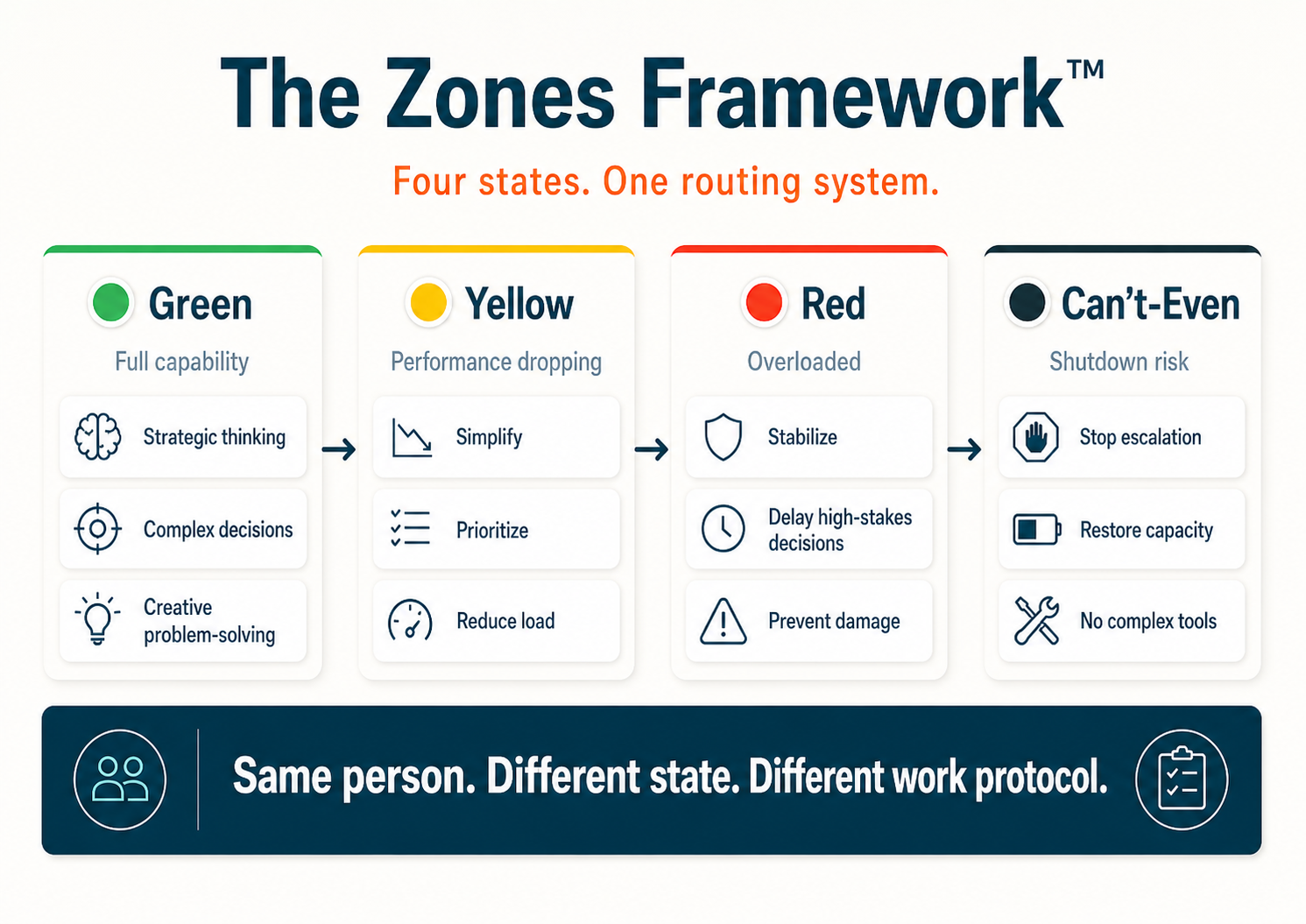
Capacity state isn't a single dial. The Zones Framework™ describes four operating states people move through during a working week: 🟢Green Zone (full capacity), 🟡Yellow Zone (compromised but functional), 🔴Red Zone (running on reserves), and ⚫Can't-Even Zone (below functional threshold). The skill of reading which state you're in - and which state the people around you are in - is what we call Capacity Intelligence™. The table below uses "Yellow state" and "Red state" as shorthand for the same idea.
How trait labels translate to state realities
Here's what the shift looks like in the labels you already use. The middle column is what's actually happening. The right column is where to look first.
| Trait label | State reality | What to check first |
|---|---|---|
| Lazy | Capacity below current task threshold | What's changed in their load over the past two weeks? |
| Unmotivated | Sustained operation without recovery (Recovery Debt) | When did they last have a real recovery window? |
| Procrastinator | Task demand exceeds available capacity | Is the task too large for the day, or for the person right now? |
| Scattered | Yellow state with too many concurrent open loops | How many distinct priorities are they holding this week? |
| Forgetful | Working memory load exceeds available capacity | What just got added to what they're already tracking? |
| Indecisive | Decision volume exceeding what current state can support | How many decisions have they made this week versus a normal week? |
| Short-tempered | Red state with no recovery buffer | What load have they absorbed in the last 72 hours? |
| Reactive | Operating below threshold, defaulting to whatever's loudest | Is the person in Red, or is the environment hitting them too hard? |
| Disorganized | Capacity below current organizational load | Has the load grown faster than their systems can absorb? |
| Unreliable | Output varies because conditions are inconsistent | What's inconsistent in their week-to-week conditions? |
| Checked out | Sustained Red; output reduced to preserve remaining capacity | When did the pattern start, and what preceded it? |
| Difficult | Operating in Red in this specific context | Where does the behavior appear, and where doesn't it? |
| Burned out | Recovery Debt past the breaking point | Has there been any real recovery in the last quarter? |
| Slow to execute | Cognitive bandwidth below task complexity | Is the task harder than usual, or is the person at lower capacity? |
| Resistant to change | Capacity at ceiling, no headroom for additional load | What else are they already absorbing right now? |
| Disengaged | Output suppressed by sustained demand without offset | What sustained demand is going unaddressed? |
| Defensive | Red state, protecting limited capacity from additional load | What demand is hitting them right now that they can't absorb? |
If most of the right-hand column is unknown to you for a given person, that's the diagnostic. You don't have enough information about their operating conditions to be drawing conclusions about their character. The "Burned out" row deserves special attention - what looks like a motivation problem after sustained Recovery Debt is almost never a motivation problem, and treating it as one usually accelerates the underlying state collapse. See the work on motivation and emotional resilience for what the operational alternative looks like.
Why this matters operationally
The trait frame is self-confirming. If you decide someone is unreliable and act on that decision (write-up, PIP, lost promotion), the resulting load increase usually degrades their state further. That produces more of the behavior you labeled, which confirms the label. The person hasn't become more unreliable. Their conditions have gotten worse, and the worsening was partly caused by the intervention.
The state frame is testable. Check the load and recovery picture before you act. If the behavior is conditional, the intervention is operational: reduce the load, restore the recovery window, change the demand timing. The behavior usually resolves within weeks, not quarters. The person you were about to write up turns out to be the person you had six months ago, operating in different conditions.
This is also why some of your managers consistently get better output from the same headcount than others. They're not better at motivating people. They're better at reading state and timing demand. They're running a different operating system, mostly without language for what they're doing. That readable, trainable skill is Capacity Intelligence™, and the absence of it across an organization is what the hidden economics of workplace capacity actually measures - the gap between the output you're paying for and the output your conditions are letting you collect.
Some behaviors aren't capacity questions
Ethics issues, repeated conduct violations, and performance gaps that persist after capacity is restored need a different conversation. The point of this page is to rule out the capacity question first, not to explain away every performance problem. If you've genuinely fixed the load and recovery picture and the behavior persists, you've got a different problem - and now you know it.
Find out what state is actually costing you.
The Capacity Audit (2 to 4 weeks) maps your operation's demand-capacity equation and quantifies what each of these patterns is costing you in output and turnover. The deliverable is an operational remediation plan with measurable targets, not a culture report.