The most expensive variable in your organization
is the one you're not measuring.
Skills don't disappear under pressure. They go offline. The senior manager who handled crisis brilliantly in March writes a career-limiting email in November. Same person. Same skills. Different state.
Capacity shows up in individuals. What's draining it is coming from how the work itself is structured. Emergent Skills works at both levels. Skip either and the other fails.
Executive Summary How it works. What it costs. How to start. +
Capacity drops months before your KPIs do.
Capacity is how much of their own skill set your people can actually access right now. It fluctuates daily, in everyone, measurably. The same team executes brilliantly at 10 AM and produces an expensive error by 3:30 PM. The skills did not disappear at lunch. Access to them dropped.
The cost runs roughly $5M annually for a 1,000-employee company, drawn from a peer-reviewed CUNY/Johns Hopkins model. The cost concentrates in five organizational patterns: Meeting Tax, Decision Density Tax, Recovery Debt Tax, Manager Load Tax, Forfeited Upside Tax. Recovery Debt and Forfeited Upside anchor the top-line capacity cost. The other three are diagnostic lenses showing which patterns concentrate the cost and which interventions map to it.
The engagement is sequenced. Audit (3 to 8 weeks) diagnoses where capacity is dropping and what it is costing. Pilot (12 weeks) implements the framework with one team and produces a case study built from your data. License deploys the system at scale, with quarterly executive reviews tracking your capacity cost top-line.
Pricing. Audit starts at $15K to $25K for a single team (5 to 15 people), scaling through Department, Function, and Enterprise tiers. Pilots typically scope between $120K and $180K. License tiers start at $480 per employee per year on Foundation (200+ employees, $96K minimum). Audit and Pilot fees credit against first-year License fees.
Three Design Partner slots for 2026. Senior consultant leads the engagement, with the founder personally involved at the key moments. Anchor case study positioning when the firm scales past the design partner phase. Design Partners receive 15% off the first engagement.
Not wellness. Not therapy. Not engagement. Operating design for the variable that determines what your organization actually produces.
What This Looks Like Before You Have a Name For It
Most leadership teams have already lived through several of these. Nobody filed them under "capacity." They got filed under whoever was in the room.
Your best manager just made the worst call of the quarter.
The team that crushed Q2 is somehow gridlocked on Q3. Same people. Same skills.
Your highest performer just quit and nobody saw it coming.
A 30-minute meeting just consumed two hours. Nothing got resolved. Everybody's tired.
Three senior people are in conflict and all of them are right about the facts.
You spent $200K on leadership training and nothing changed on the floor.
These look like performance problems, or culture problems, or hiring problems. They almost always get solved as one of those things. The variable underneath them rarely gets measured, which is part of why the same scenes keep playing out.
The operating principle
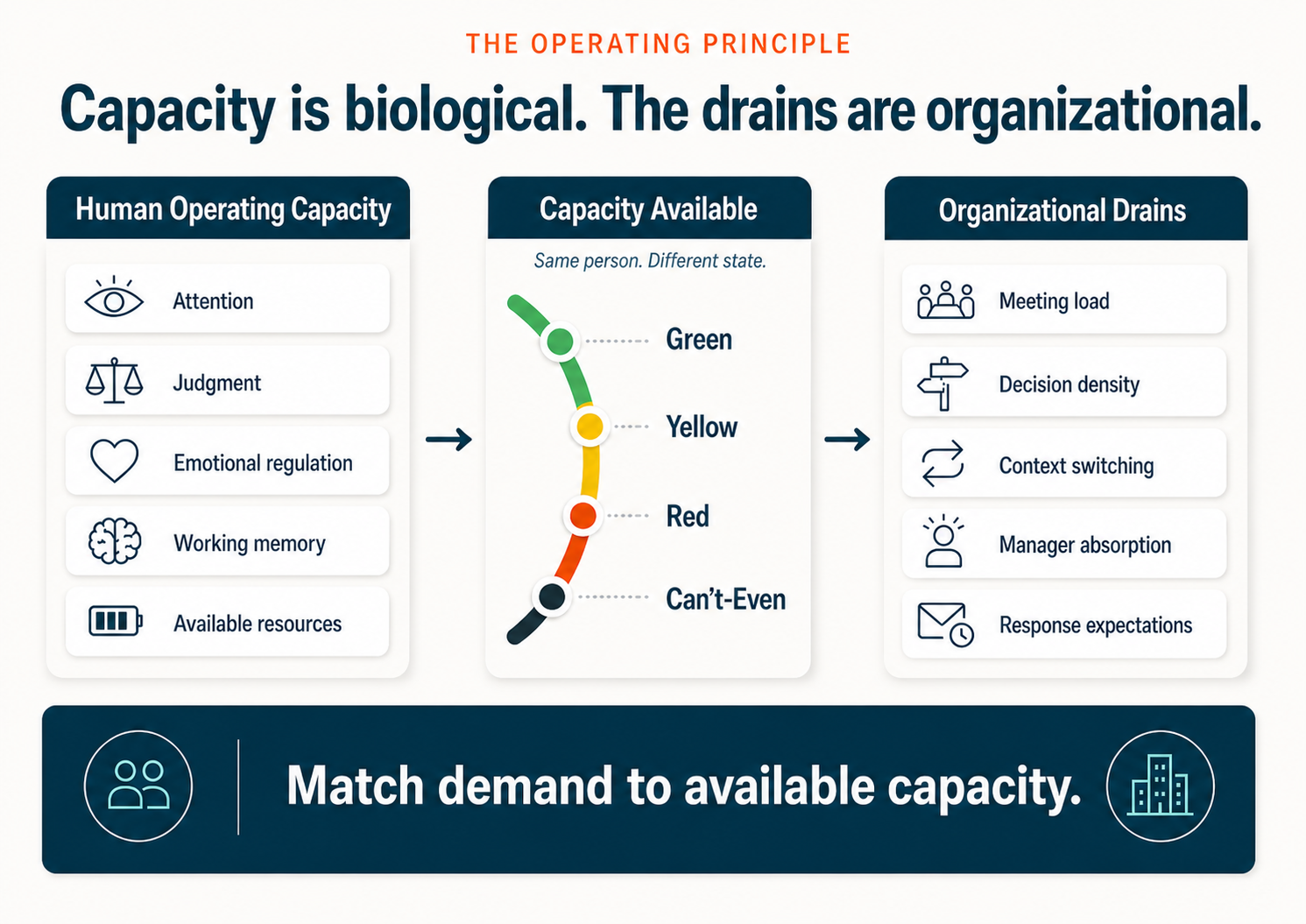
Capacity is biological.
The drains are organizational.
Capacity is how much of their own skill set your people can access at any given moment. It moves hour to hour. The things draining it (meeting load, context switching, decision density, the way work flows through your organization) aren't natural laws. Somebody designed them. Which means they can be redesigned.
Research context: A 2026 study in Science Advances found that daily capacity fluctuations cost the equivalent of 30 to 40 minutes of productive work per day, and that grit and conscientiousness do not protect against the drops. A CUNY/Johns Hopkins computational model estimates that unmanaged capacity costs a 1,000-employee company roughly $5 million per year.

Built by a Systems Thinker
Jim Wilde, founder of Emergent Skills. Decades of enterprise systems work, including nine years as a consultant and lead developer on the public-facing digital application for the Metropolitan Transportation Authority. The mta.info platform millions of people depend on every day.
Capacity Intelligence is documented in full in his book CAPACITY: The Variable No One Measures. Standard engagements are led by senior delivery consultants. The founder owns the methodology, judgment calls on edge cases, and is closer to the work for Design Partner engagements at the key moments.
The Zones Framework™
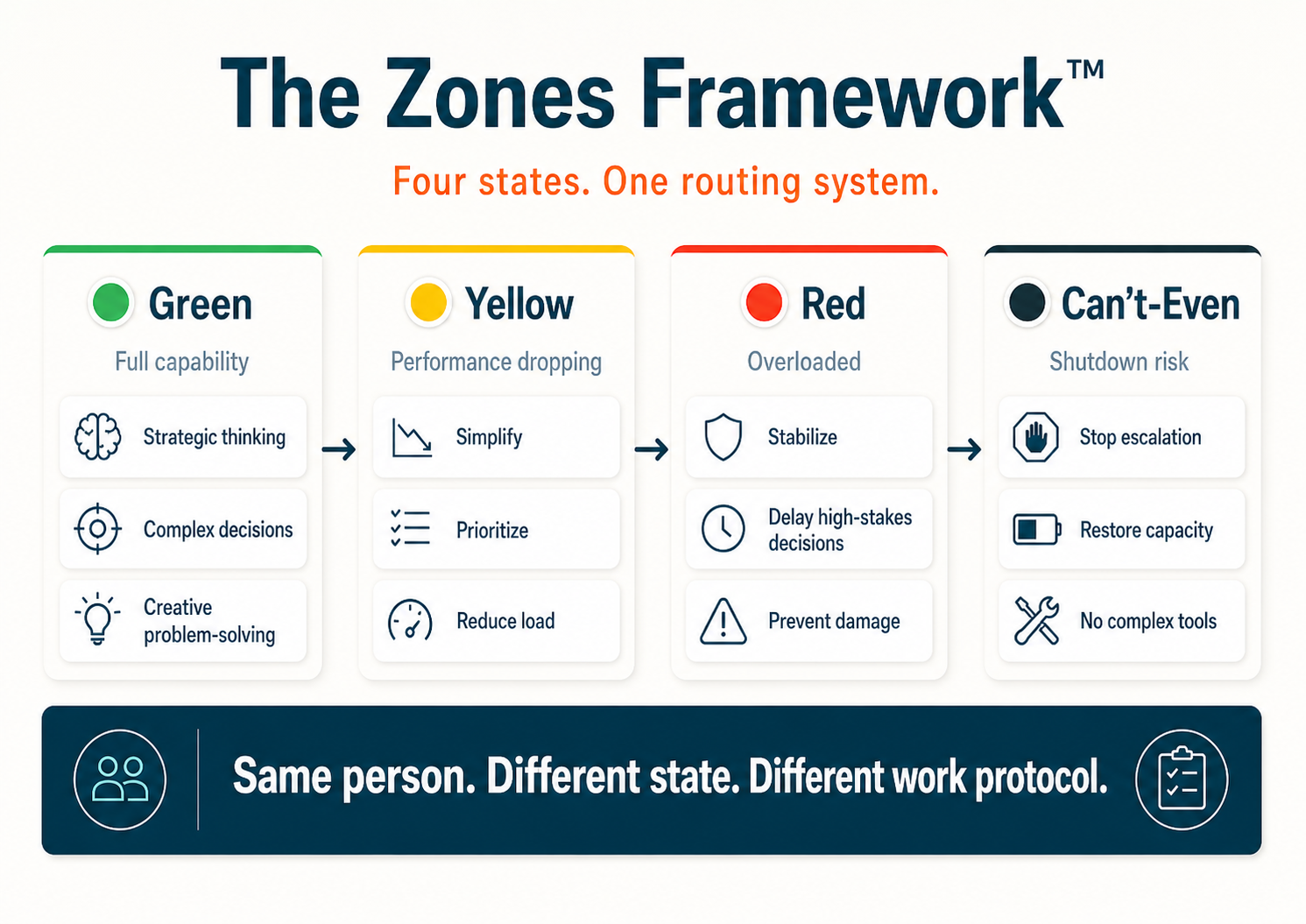
Four states. One routing system.
The Zones aren't a personality model. They're how you route work to the state that can execute it.
How it operates
The Zones Framework runs as a daily operational tool through the Capacity Zones platform. Already deployed with individual professionals and available to enterprise teams as part of the License tier. The framework isn't theoretical. It's running.
Where Capacity Cost Concentrates
Different industries tend to drain capacity in different places. Recovery Debt and Forfeited Upside anchor the top-line capacity cost across every audit. The pattern that varies by industry is which of the other three taxes (Meeting, Decision Density, Manager Load) most often concentrates the diagnostic signal.
Pharma, Biotech, and Innovation-Dependent Organizations
Dominant tax: Forfeited Upside. The strategic move your team would have seen at Green capacity. The pipeline opportunity that got captured and never developed. The competitor who moved first because your organization was too depleted to connect the dots. For organizations whose competitive advantage runs on pattern recognition and creative output, this is typically the largest single tax.
Financial Services and Investment Firms
Dominant tax: Decision Density. Consequential decisions made in depleted capacity states. The Yellow-zone call that costs real money, the Red-zone trade that should have been a pass, the late-afternoon approval that didn't get the scrutiny it needed. Where stakes are high and density is relentless, decision quality under depletion is the cost center.
Professional Services, Law, and Consulting
Dominant taxes: Meeting and Recovery Debt. Billable hours quantify what unmanaged capacity costs with unusual precision. Every hour spent in a reactive meeting is an hour not billed. Every recovery debt that burns out an associate is training investment written off. The economic model makes the capacity problem unusually visible. And unusually expensive.
Healthcare Systems and Clinical Operations
Dominant tax: Manager Load. Clinical managers carry their own cognitive load plus the absorbed load of their teams. Manager depletion in healthcare correlates directly with clinical error rates, team turnover, and the retention problem driving the staffing crisis. When the managers can't carry it, the system can't function.
Your organization's pattern may cluster differently. The Capacity Audit identifies which taxes are concentrating your cost and in what proportion.
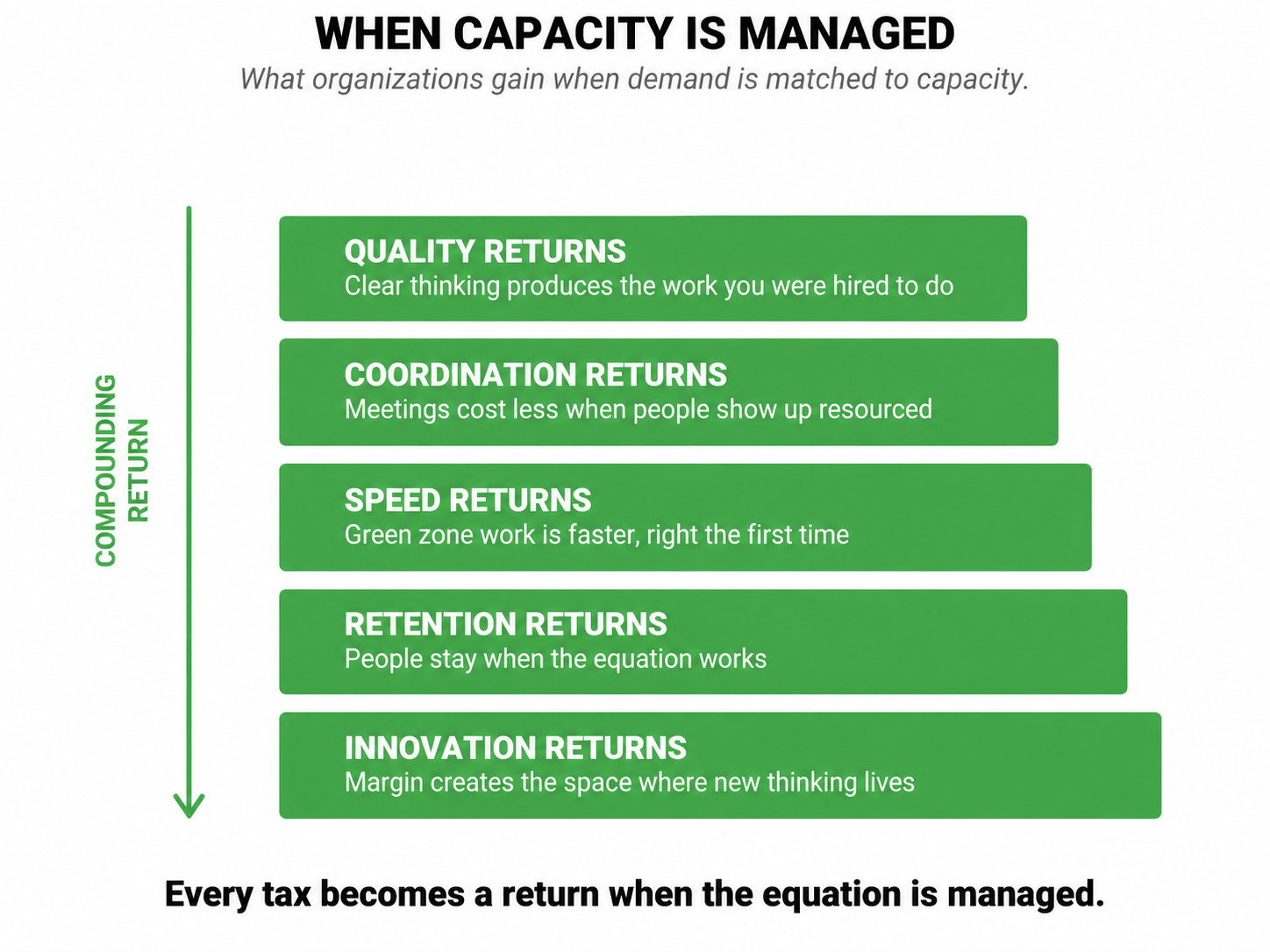
What Changes When Capacity Is Managed
The 3:30 PM Decision Stops Happening
When your people can read their own state before a high-stakes moment, the expensive late-afternoon call stops getting made. The judgment was always there. They couldn't reach it at 3:30. Now they can.
Reactive Communication Drops
The emails that torch relationships, the meetings that escalate instead of resolve, the feedback that lands wrong. These aren't character flaws. They're capacity signals. Your managers learn to see them and intervene before the damage lands.
The Drift Becomes Visible
Right now, you see the resignation letter. You see the blown deadline. You see the conflict. With capacity as a managed variable, you see the trajectory weeks before the event. That's the difference between firefighting and infrastructure.
Training Actually Lands
Most L&D fails because the people in the room don't have the capacity to absorb what's being taught. The content might be excellent. Doesn't matter. They can't reach it. Deploy training when capacity is there to receive it, and your development budget stops vanishing into people who couldn't use it.
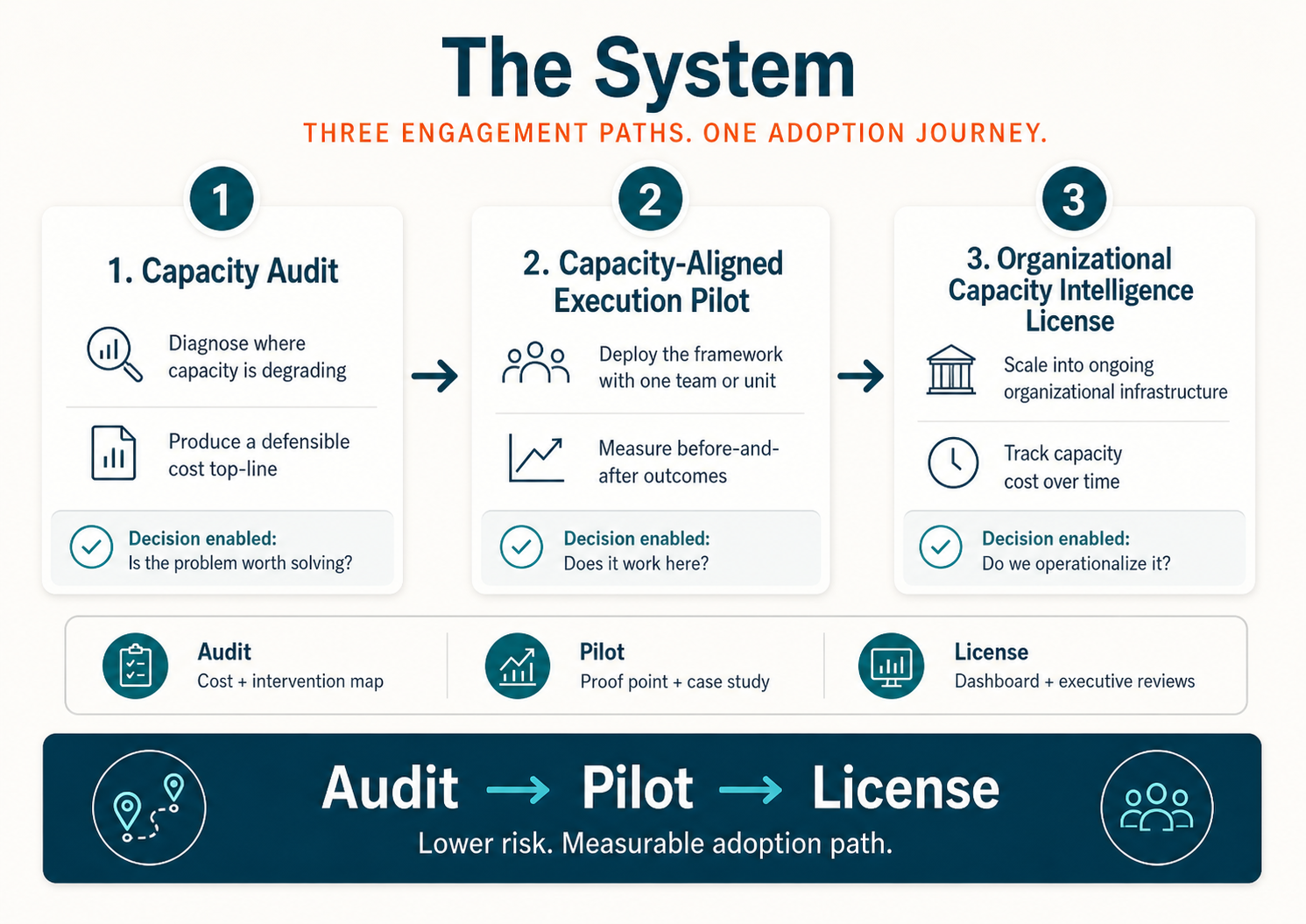
Three engagement paths, scaled to different stages of organizational commitment. The audit comes first whether you stop there or continue. The pilot comes next when you do. The license is for organizations that decide capacity is infrastructure, not a project.
Capacity Audit
A structured assessment of where capacity is degrading across your organization and what it's costing. Recovery Debt and Forfeited Upside anchor a defensible organizational capacity cost top-line. The other three taxes (Meeting, Decision Density, Manager Load) are diagnostic lenses showing which patterns concentrate the cost. You get a report your CFO can read, and a ranked list of interventions.
Capacity-Aligned Execution Pilot
A 12-week engagement with one team or business unit. The full framework deployed, before-and-after measurement, and a case study your organization owns. Every scaled rollout needs a proof point. The pilot produces yours.
Organizational Capacity Intelligence License
An annual license that deploys the full system as ongoing organizational infrastructure: the Zones Framework as shared language, Manager Capacity Certification in annual cohorts, an organizational capacity dashboard, and quarterly executive reviews against the capacity cost top-line. The license is what this looks like when an organization decides it isn't a project to finish.
For your budget conversation
Audit engagements scale by tier: $15K to $25K for a single team (5 to 15 people), $35K to $55K for a department (15 to 75), $65K to $95K for a function (75 to 300), with custom pricing for enterprise-wide engagements. Pilots typically scope between $120K and $180K. License pricing is annual and tiered by knowledge-worker headcount, starting at $480 per employee per year.
Every engagement is benchmarked against the capacity cost top-line the audit produces, so the spend has a number sitting next to it before it gets approved. Full pricing →
2026 Design Partner Cohort · Three Slots
Early adopters shape the category.
Three Design Partner slots are available in 2026. Senior consultant leads the engagement, with the founder personally involved at the key moments. Anchor case study positioning when the firm scales past the design partner phase. Design Partners receive 15% off the first engagement. For organizations whose leadership is comfortable being early adopters of a new category.
Apply for a Design Partner Slot →
Applications close when the three slots are filled.
Questions
It makes them work. Most training is delivered without regard to whether participants have the capacity to absorb it. The Zones Framework gives your L&D team a capacity layer. Deploy training when people can use it, and stop wasting budget delivering it when they can't.
A 12-week engagement with one team or business unit. Weeks 1-2 establish the baseline. Weeks 3-10 deploy the four intervention dimensions. Weeks 11-12 measure outcomes and produce the case study. You walk away with the dataset and the findings on your own people, whichever way they land, including the parts that don't flatter the intervention.
Start with the Capacity Cost Calculator, which models what unmanaged capacity is costing your team today, using your own numbers. A Capacity Audit refines that baseline into an organizational capacity cost top-line built from your labor and opportunity valuation. A Pilot measures the delta on that top-line before and after 12 weeks of structured intervention. A License tracks the delta at the organizational level through quarterly reviews. The math is concrete at every level.
No. Individual usage is completely private. No employer visibility, no manager dashboards showing who used what. The organization gets aggregate capacity data and outcomes. Employees get a private tool they'll actually use because they trust it. That trust is the product.
Your strategy is only as executable as your workforce's capacity to execute it.
Skills, judgment, communication. None of it shows up reliably without capacity behind it. Emergent Skills makes that variable visible and operational. Both at the individual level and at the demand draining it.