Curriculum
Ten professional skills. Built for the floor, scaled to the ceiling.
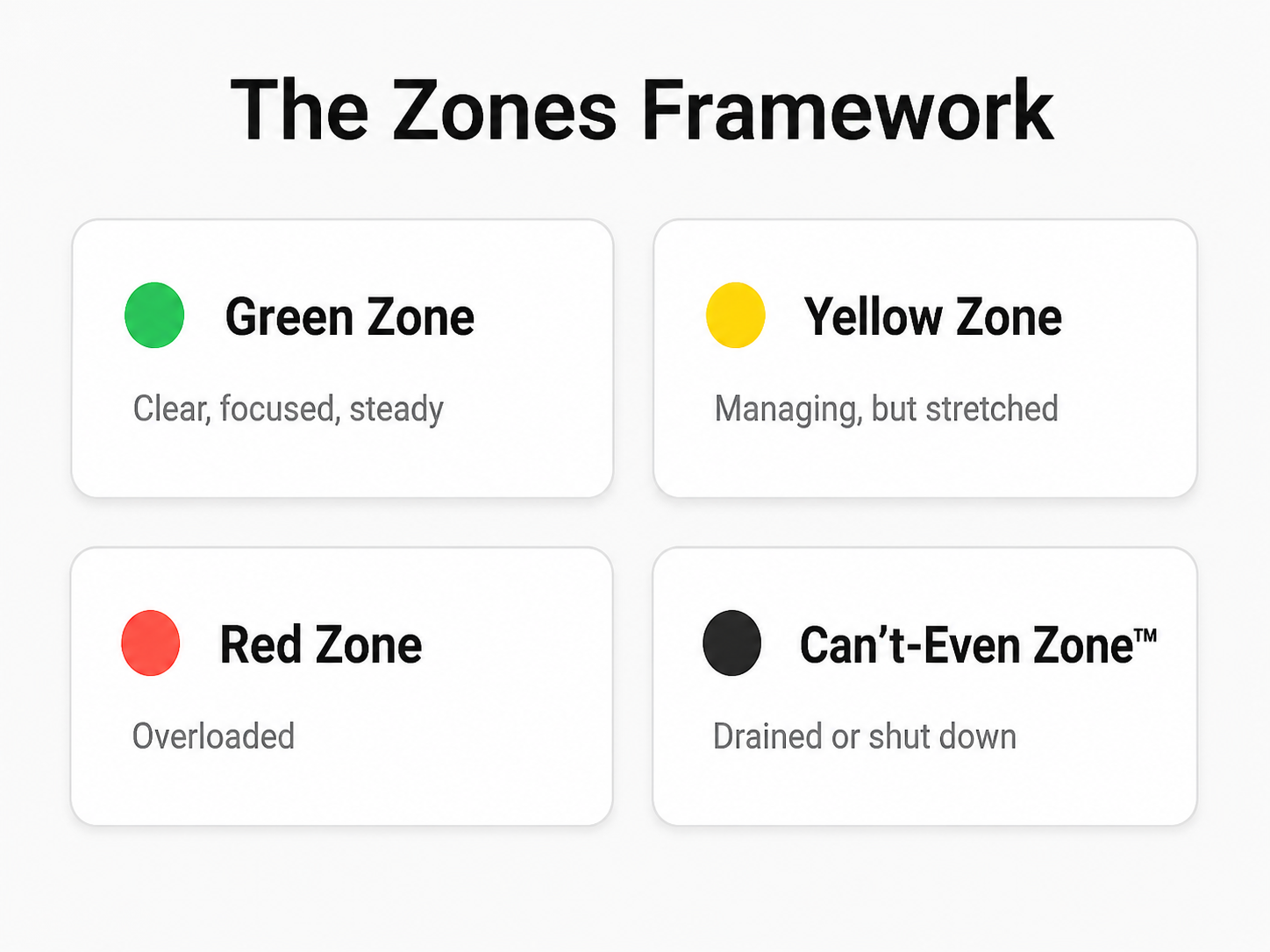
Most workplace training is built for a person who isn't in the meeting. The failure mode has a name: the Green Zone Trap. Conventional training is built for 🟢Green Zone capacity and delivered to a workforce that lives in 🟡Yellow Zone and hits 🔴Red Zone exactly when the program needs to work.
It assumes a participant who is rested, alert, and able to absorb new content. That person exists. They are not the person you are trying to reach. The person you are trying to reach is in their fourth hour of context-switching, two emails behind, and one bad decision away from a Yellow afternoon. That person cannot run a six-step framework. They can press their feet into the floor.
This curriculum is built for that person first, then scaled up. The design principle is "build for the floor, scale to the ceiling." The most depleted user gets the most attention. Everyone else benefits from that decision.
The curb-cut principle
Curb cuts were designed for wheelchair users. The people who use them most are parents with strollers, delivery workers with carts, and travelers with luggage. Build for the constrained case and the design works better for everyone. Build for the unconstrained case and most of your users are excluded most of the time.
Conventional training builds for the unconstrained case. The work that brought the participant to the program is never happening in Green. This is what Neurodivergent-First Design means in practice: engineering for the constrained case so the design holds when capacity drops.
The shape
Ten pillars, twelve weeks each, roughly ten minutes a day. Delivered as PDFs you can print, mark up, and read when your screen is the last thing you want to look at. A participant works through one pillar at a time, in three phases.
Body-first (Weeks 1-4)
Twelve tools across grounding, breath, movement, and anchoring. The first month has one job. Prove that the participant's nervous system responds to deliberate input. Without that proof, nothing after Week 4 lands. The Week 4 check is the proof gate. It answers a single question: can the participant shift their own state? Everything that follows depends on the answer being yes.
Cognitive (Weeks 5-8)
Cognitive tools layered on top of the body-first base. Reframes, evidence collection, pattern interrupts, daily rituals. By Week 8 the participant recognizes their own zone without thinking about it. That is what we are training. Not awareness in the abstract. Recognition that runs at the speed of a conversation, before the bad decision is made.
Strategic (Weeks 9-12)
The participant uses Green capacity deliberately instead of letting it leak. They plan around their real capacity instead of their idealized capacity. By Week 12 the zone distribution has measurably shifted from where it was on Day 1. The participant can name what changed in their work.
Four versions of every tool
This is the part most training gets wrong.
A tool that works at 🟢Green Zone does not work at 🔴Red Zone. Asking a Red participant to do a six-step grounding sequence is asking them to use the exact cognitive resources they just lost. They will not complete it. They will conclude the program does not work.
Every tool in the curriculum exists in four versions, sized to where the participant actually is, not where the training assumes they should be.
| Zone | Version | Duration | What the participant does |
|---|---|---|---|
| 🟢 Green | Full | 3-5 min | Six-step grounding sequence with breath, pressure, and awareness |
| 🟡 Yellow | Smaller | 1-2 min | Three steps: press, squeeze, breathe |
| 🔴 Red | Tiny | 30 sec | Press feet. Feel floor. One breath. |
| ⚫ Can't-Even | Crisis | 5 sec | Press heels. Feel ground. |
Same tool. Four entry points. The Tiny and Crisis versions are not simplified versions of the Full tool. They are engineered separately for the cognitive constraints of those states. A participant in Red who attempts the Full version will not complete it. That is not a participant failure. It is a design failure of conventional training.
This single decision is what makes the curriculum work for the population it was built for.
Ten professional skills - these are pillars.
Each pillar follows the same three-phase, four-tier architecture. Different content, same shape.
- Composure & Performance Under Pressure
- Stress Load & Sustained Output
- Execution & Delivery
- Focus & Attention Control
- Communication & Connection
- Emotional Regulation & Recovery
- Resilience & Change
- Confidence & Standing
- Motivation & Drive
- Rest & Recovery
Where a participant starts depends on what is costing them most. A new employee facing high-stakes meetings starts with Composure & Performance Under Pressure. A team running on fumes starts with Stress Load & Sustained Output. An R&D group losing attention to context-switching starts with Focus & Attention Control. After 90 days, the participant moves to a second pillar or repeats the first with deeper practice.
Deployment
Printable PDFs are the format because PDFs work when the participant cannot look at another screen. They work offline. They do not require an LMS. They remain readable when executive function is offline, which is the moment when most training fails by design.
The Capacity Intelligence Assistant runs alongside the curriculum as the live intervention layer. The lessons build the skill. The Assistant is for the moment. Two tools, different jobs.
A license includes the full curriculum, the Assistant for all participants, senior consultant onboarding for the pilot cohort, and reporting at Weeks 4, 8, and 12. Manager dashboards show cohort-level zone distribution and recovery patterns. Individual data is never exposed. The engagement runs Audit, Pilot, License.
Sample
The first four weeks of Confidence & Calm Under Pressure. The complete Reset Phase: twelve tools, the Week 4 proof gate assessment, and the workbook pages used to measure outcomes.
Capacity Intelligence™ · The Zones Framework™
Skills training. Not therapy. Not wellness.