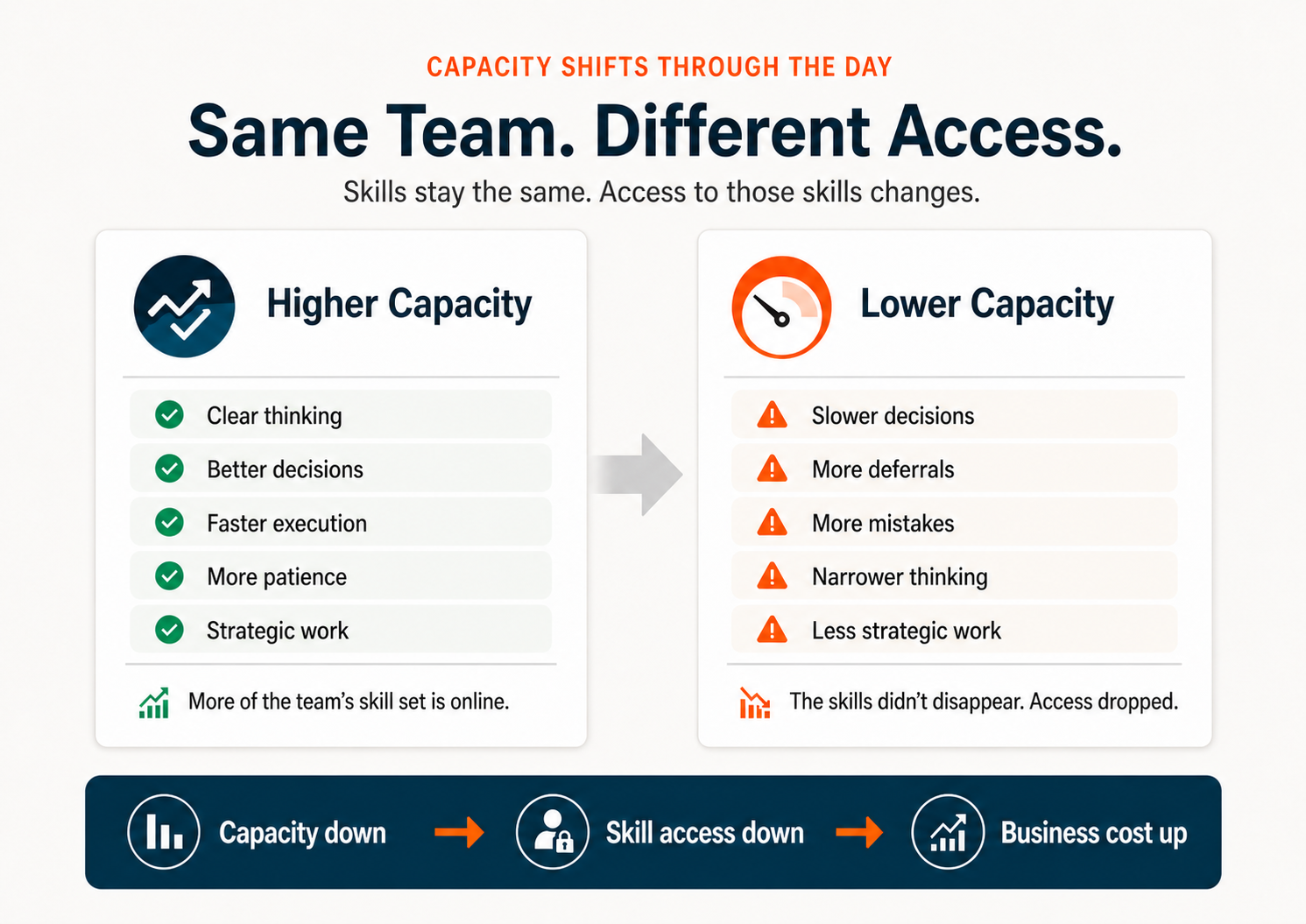
Same team.
Different access.
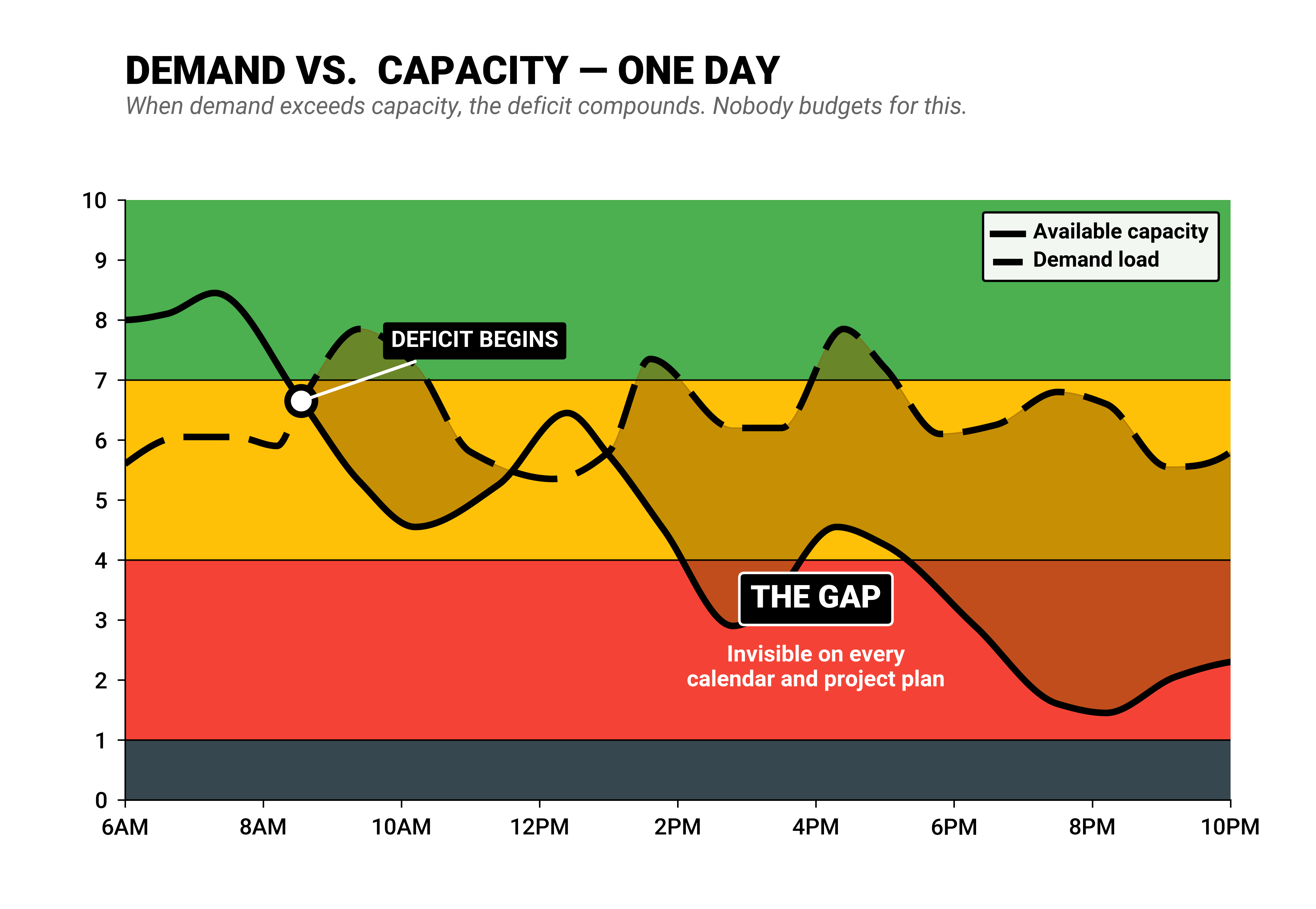
The same people who make the sharp call at 10 AM ship the avoidable mistake at 4 PM. Their skills did not disappear over lunch. Access to those skills dropped. Capacity is that access. It fluctuates daily, in everyone, measurably. We put a number on what your organization loses when it drops, and build the operating discipline that manages it.
Not wellness. Not therapy. Not engagement. Operating design for the variable that determines what your organization produces.
We do not label performance problems as capacity problems unless they pass four tests.
Built for the operators who run the business: COOs, VPs of Operations, Chiefs of Staff.
Executive SummaryThe variable your operating model does not measure.+
Capacity is how much of their own skill set your people can reach on a given day. It is variable, finite, and the determining factor in the quality of every decision the organization produces. Skills do not deliver themselves. They run on access.
Most operating models miss it. Performance reviews measure output. Engagement surveys measure sentiment. Neither measures whether your team could reach its best thinking when the decision got made.
The cost concentrates in five patterns the audit names and prices: Meeting, Decision Density, Recovery Debt, Manager Load, and Forfeited Upside.
The engagement is sequenced. Diagnostic is a half-day session that maps your patterns to the five taxes and tells you whether a full audit is warranted. Audit diagnoses where capacity drops and what it costs. Pilot proves the fix on one team, including the Manager Execution Capacity Cohort running concurrently on the pilot manager, and produces a case study built from your data. License deploys it at scale with annual MCC cohorts built in.
The Five Taxes identify where cost is concentrating. Capacity Intelligence™ measures it. The Zones Framework™ explains it. The app, OSA, and Pillars help reduce it.
Three Design Partner slots for 2026, for leadership teams comfortable being early in a category before the case studies exist.
What The Audit Prices
Five Capacity Taxes
The cost shows up in five patterns. The audit reports a defensible floor plus two separate additions, never one blended figure. The floor is the operational capacity cost: the output lost when people are present but working in degraded states, built from your own data. Meeting, Decision Density, and Manager Load are diagnostic lenses that explain that loss rather than add to it. On top of the floor the audit adds the Recovery Debt Tax (the replacement cost of regretted attrition, from your turnover data) and reports the Forfeited Upside Tax separately (the value left on the table, co-authored from your pipeline, usually the largest).
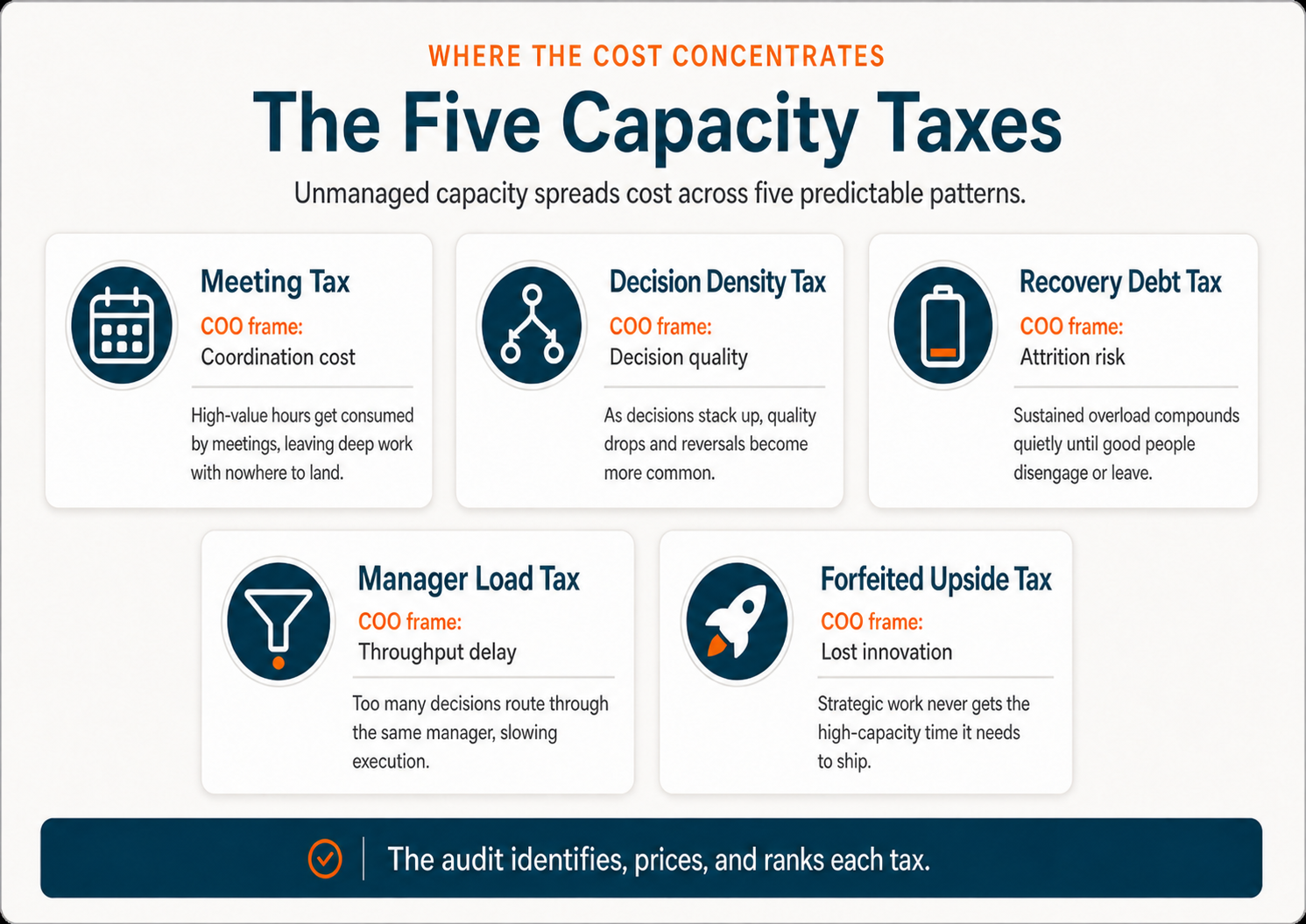
Meeting Tax (coordination cost)
Coordination overhead eating the hours when capacity is highest, so the hardest thinking has nowhere to land.
Decision Density Tax (quality cost)
The reversed call, the missed flaw, the rework. Errors cluster in the back half of the day and the back half of the week, where capacity is lowest.
Recovery Debt Tax (attrition cost)
The replacement cost of regretted attrition, concentrated on your highest-trust people. It compounds in private and is usually visible too late to keep the person.
Manager Load Tax (delay cost)
Delivery delay from decisions bottlenecked through one overloaded manager. Manager depletion is the leading indicator: it shows up before any team-level signal does.
Forfeited Upside Tax (missed signals, connections, and innovation)
A depleted team member still completes the visible work. What they miss are the signals, connections, and improvement ideas that create future value. The customer cue that suggests a product gap. The competitive signal someone noticed but did not have the bandwidth to act on. For organizations whose edge is pattern recognition or creative output, this is usually the largest tax of the five.
What It Is Costing You
Capacity loss is priced against fully loaded compensation, so the dollar value of a degraded week rises with the cost of the people having it. Your most expensive people are your knowledge workers. A 2025 CUNY/Johns Hopkins model puts the loss at roughly $5M per year for a 1,000-employee company. Pick whichever industry benchmark you find credible. The audit produces a figure specific to your organization.
The calculator produces a directional number from your own numbers in about five minutes.
Where The Risk Concentrates
The load lands on the people you can least afford to lose.
Capacity drops when the work spends cognitive and emotional resources faster than the people doing it can restore them. Not weakness. Not effort. Load. And it does not land evenly. It lands hardest on your most capable people, because they are the ones trusted with the hardest problems, the most complex decisions, and the rescue work.
The senior IC carrying three teams off the org chart. The director everyone routes escalations through. They absorb the most, signal it the least, and deplete in private long before anything shows up in a review. When it surfaces, you do not lose a headcount. You lose the load-bearing wall.
The 2024 to 2026 AI wave did not fix this. It runs the load hotter. The work of separating usable AI output from plausible-but-wrong output routes through your most senior people, the exact ones already carrying the most. More volume through the same bottleneck, no added capacity.
Who This Is For
Built for organizations whose output depends on cognitive performance under pressure.
Capacity matters everywhere, but the cost is largest where the work is knowledge work and the people are expensive. Four sectors where we see it concentrate.
Pharma, Biotech & Innovation-Dependent
Where the edge is discovery, Forfeited Upside is the largest tax in the system. The insight a scientist would have caught at full capacity and missed at partial does not show up as a loss on any line. It just does not happen. Capacity drops slow pipelines and forfeit the breakthroughs the model depends on.
Priority Focus
Financial Services & Investment Firms
The highest comp per head in any business, so a degraded week is most expensive here. In private equity especially, deal teams run hottest exactly when stakes peak: late diligence, IC prep, the back half of a process. The associate who catches the flaw in week one misses it in week six. We start on the firm's own deal team, then scale across the portfolio.
Professional Services, Law & Consulting
Billable cognition is the product. Decision quality and creative output are what clients pay for, and both degrade with capacity. The depletion shows up as rework, missed angles, and the regretted attrition of exactly the people clients ask for by name.
Healthcare Systems & Clinical Operations
Capacity errors here carry clinical stakes, not just commercial ones. Clinician depletion is both a patient-outcome problem and an attrition problem, and it concentrates on the most experienced people the system can least afford to lose. We audit the knowledge-worker and clinical-decision layer, not the operational floor.
How The Fix Works
Three altitudes. The audit tells you which one to start at.
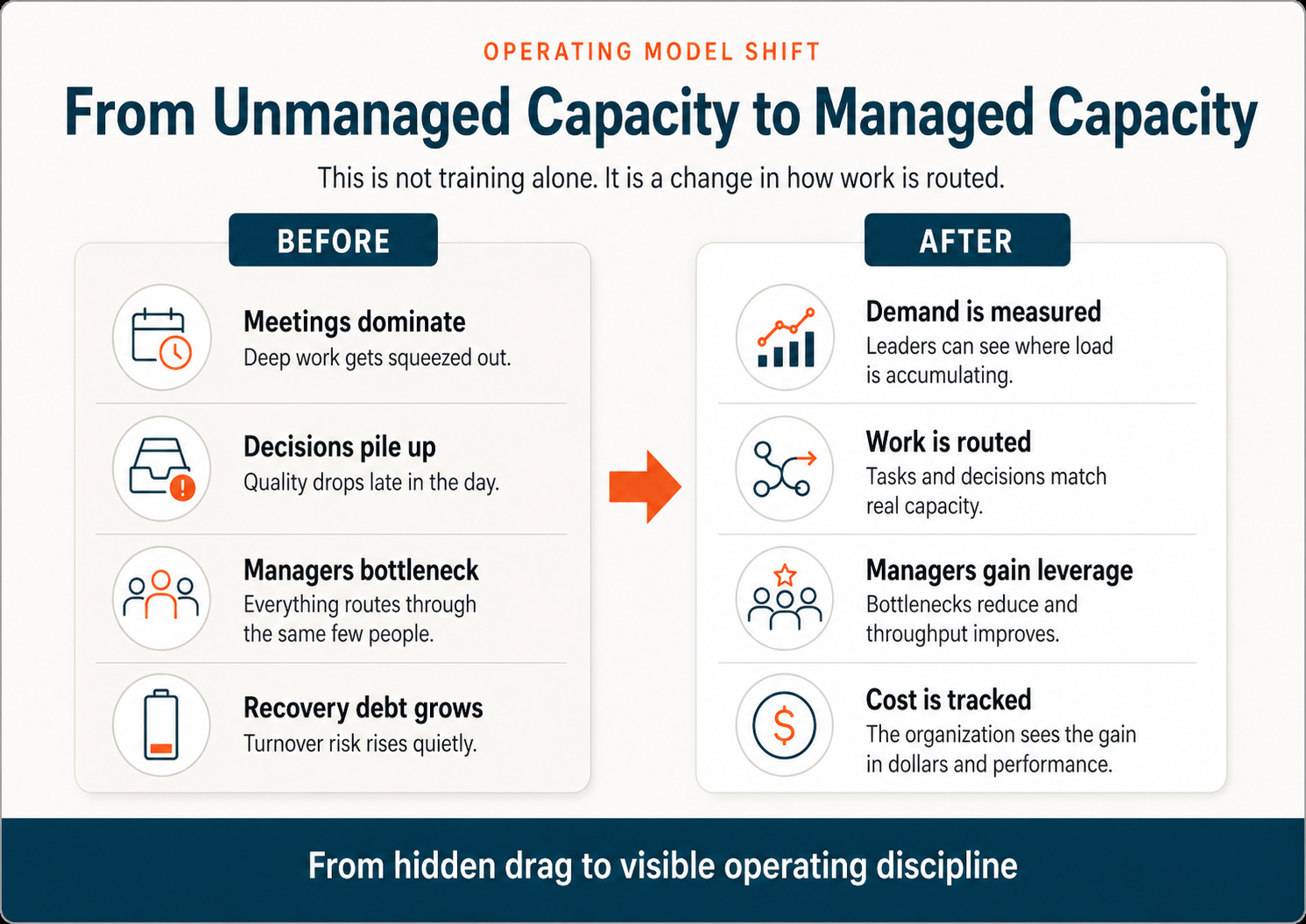
The fix is not one thing. It operates at three levels, and each one reaches what the other two cannot. Anyone selling a single layer is selling a partial fix.
Organizational: Demand Design
Most organizations fund five strategic initiatives and cognitively resource zero of them, so the same people run all five at seventy percent and none gets the full thinking it needed. Demand Design budgets capacity the way finance budgets cash: cost the demand before you create it, cap total load below a hundred percent, and run three things at full quality instead of five at partial. The ambition does not shrink. The waste does.
Managerial: Manager Execution Capacity Cohort
Most organizations have one manager whose team consistently outperforms and nobody can quite say why. They manage capacity by instinct: absorbing noise, timing demands to the team's state, protecting the thinking time. Certification turns that instinct into a repeatable operational capability that scales past one person and survives them leaving. Five practices, six weeks, a cohort of 8 to 12 managers. Assessment by demonstrated practice in real operating conditions, not test scores.
Individual: The Emergent Skills App
Demand Design and certification change the system, but neither is in the room at 2:47 on a Tuesday when your best person makes a depleted call. The app is. Private, state-matched tools, two routes (neurodivergent and neurotypical), that let an individual catch the low-capacity state before the decision instead of after the reversal. No manager visibility. No surveillance.
How An Engagement Works
Prove it on one team. Then scale what worked.
Three stages, sequenced because evidence from one makes the next land. Most organizations start with a single team or department, then scale across the function, the firm, or in multi-site and multi-entity organizations, across locations or portfolio companies.
Standard Path
Start
Calculator
Free · 5 min
Step 1 · Diagnose
Audit
3 to 8 weeks
Step 2 · Prove
Pilot
12 weeks
Step 3 · Scale
License
Annual
Entry Points Before the Audit
Not sure yet · Lowest commitment
Work Demand Diagnostic
Half-day · 6–10 people · $3.5K–$7.5K
Three hours. We map the patterns the room names to the five capacity taxes, run the cost calculator live against your own numbers, and leave you with a one-page summary and a directional cost floor. Tells you whether a full audit is warranted and where it should point first. Details →
Explore · Work Demand Diagnostic
Not ready to commission a full audit? The Work Demand Diagnostic puts the framework in the room for half a day. You bring the execution pattern you have been watching. We map it to the five capacity taxes, run the cost calculator live against your own numbers, and leave you with a one-page summary of what surfaced and a directional cost floor. $3,500 to $7,500 depending on team size and format.
Diagnose · Capacity Audit
A structured assessment of where capacity drops, what it costs, and what fixes it. You get a findings report your CFO can read, a one-page brief for the executive who decides, and a prioritized fix list ranked by return per dollar. Most first engagements scope to a single team or department. $15K to $25K for a team-sized audit, scaling with scope.
Prove · Capacity Pilot
Twelve weeks on one team. We implement the fix and measure before and after on decision quality, meeting load, capacity-state distribution, turnover intent, and the one business metric your sponsor cares about most. The Manager Execution Capacity Cohort runs concurrently on the pilot manager. By week ten they are credentialed and can sustain capacity-informed management after the engagement ends. You own the case study. The audit diagnoses. The pilot builds and proves the fix, which is why it carries a larger investment. A portion of audit fees credits against pilot cost when both are contracted together.
Scale · Capacity License
The system deployed as operating infrastructure: the app for the licensed population, Manager Execution Capacity Cohort in annual cohorts, and a dashboard tracking the capacity cost top-line and the patterns driving it. Priced per licensed knowledge worker, anchored to the cost it offsets. Best deployed after a pilot has produced internal evidence.
2026 Design Partner Cohort · Three Slots
Early is the advantage, not the risk.
This is a new category. The firms claiming twenty case studies and a Gartner placement are selling wellness or engagement, not capacity. The first three organizations in shape what the category becomes and get cited as the anchors when it scales. The trade is access:
- Founder involvement at the key moments. Methodology shaping at kickoff, findings review, and the executive readout. After this phase, that goes away.
- Methodology shaped to your organization while we sharpen the enterprise-scale framework.
- Anchor case-study positioning, permanently, plus 15% off the first engagement.
Who Built This
Founder
Jim Wilde built the Capacity Intelligence methodology across decades of enterprise systems work, including nine years as lead dev/pm on mta.info, the public-facing infrastructure for the Metropolitan Transportation Authority. The kind of system that does not break when twelve million riders hit it on a snow day.
The premise is simple. Capacity, how much of their own skill set people can reach right now, has been invisible to every operating model in use. Performance management measures output. Engagement measures sentiment. Neither measures access. Emergent Skills exists to make capacity measurable and managed at the executive level. The full argument is in the book, CAPACITY: The Variable No One Measures.
Senior delivery consultants lead standard engagements. The founder owns methodology and the judgment calls on findings that do not fit a clean pattern. Design Partner engagements get heavier founder involvement at the named moments above.
Start with one team.
Tell us what you are seeing: the patterns, the costs, the people you are watching. We will tell you what is driving it and whether an audit fits. If it does not, we will say so.