Capacity as Infrastructure.
Not a Program.
An annual license that deploys Capacity Intelligence™ across your organization. Managers learn to read and manage work demand. The workforce uses the app. Leadership reads the dashboard. Everyone is looking at the same variable, in the same language, at the same time. It works best after an Audit and a Pilot have produced internal evidence.
Executive SummaryCapacity becomes infrastructure, not another program.+
The license deploys Capacity Intelligence as the operating discipline that governs how your organization manages work demand and human performance under pressure. The way companies adopt Agile or OKRs, your organization adopts capacity as a managed variable.
What the license includes, five components in one operating system:
- The Emergent Skills app across the licensed workforce
- The Zones Framework as shared organizational language
- Manager Capacity Certification in annual cohorts
- The Organizational Capacity Dashboard
- Ongoing strategic partnership with quarterly executive reviews
Investment: Foundation $480/employee/year (200+ employees, $96K minimum); Scale $600/employee/year (500+ employees, $300K minimum, includes the annual Capacity Audit); Enterprise custom (typically $1M+). Audit and Pilot fees credit against first-year license costs.
Deployment: 45 to 60 days contract-to-live, with the first executive read of dashboard data about 90 days from signing. Most organizations enter through the Audit and Pilot first, since the pilot produces the baseline the license tracks against. Three Design Partner slots for 2026.
Capacity is not headcount. It is not bandwidth. It is not throughput.
It is how much of their own skill set your people can reach right now. The same team executes brilliantly at 10 AM and ships an expensive error by 3:30 PM. The skills did not disappear in five hours. Access dropped, because the work demand outran what they had left to meet it with. That is the variable nobody measures, and it decides what your organization actually produces.
The Economics
A 500-employee knowledge-worker population at the Foundation tier invests $240K annually. Against the capacity-loss economics in the 2025 CUNY/Johns Hopkins model (roughly $5M annual loss per 1,000 employees), that population represents about $2.5M in annual capacity cost. The license needs to recover about 10% of that to break even.
A 2,000-employee population at Scale invests $1.2M against a proportional $10M baseline. Break even sits around 12%, which puts the license in the same recovery band as comparable enterprise services. Turnover reduction alone is plausibly enough to clear that bar in year one. First license deployments will tell us what the realized range is, and we will publish it.
The CUNY/JHU figure is a conservative anchor, peer-reviewed and burnout-specific. The annual Capacity Audit included with Scale and Enterprise produces the full capacity cost for your business, including the upside a depleted organization forfeits in real time on top of the burnout envelope. That number is usually meaningfully larger. The license still works against the smaller anchor, which is the test that matters.
Wellness benefits have to argue for themselves against soft outcomes. Infrastructure investments do not. This is closer to the second category than the first.
What the License Includes
Five components, one operating system.
The Emergent Skills app, deployed across the licensed workforce
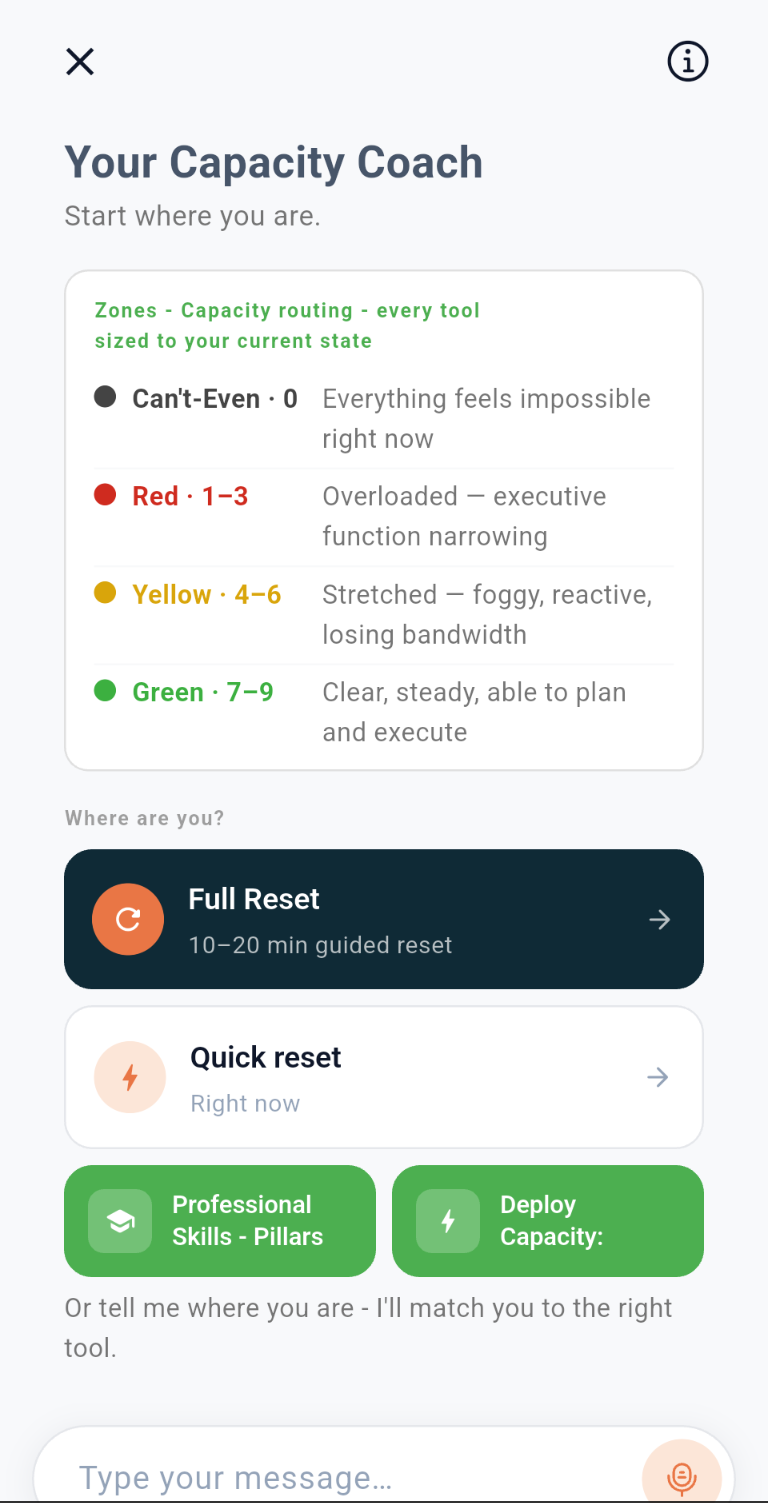 Every licensed employee gets unlimited access to both sides of the system. This is important - it helps employees get back online faster instead of losing hors.
The app architecture is built for the floor and scales to the ceiling.
When capacity is offline (Red, Yellow, Can't-Even), the app delivers zone-matched reset tools: quick reset when a meeting starts in five, full reset when they have 10 minutes, and the Professional Skills Pillars for the ten capabilities that degrade first under pressure. Two routes (neurodivergent and neurotypical). State-matched tools, not generic wellness content.
When capacity is available (Green), the app shifts to Deploy Capacity mode. Think Better, Communicate Better, Fix the Pattern, Create Better, Prepare Better. The high-judgment work that pressure usually steals gets done while the thinking is actually online. This is where the performance-infrastructure value concentrates: your best people using their best thinking on the work that matters most, instead of using whatever they have left after the day has taken most of it.
Private and text-based, around the clock. No manager visibility, no employer surveillance. The workforce uses it because they trust it.
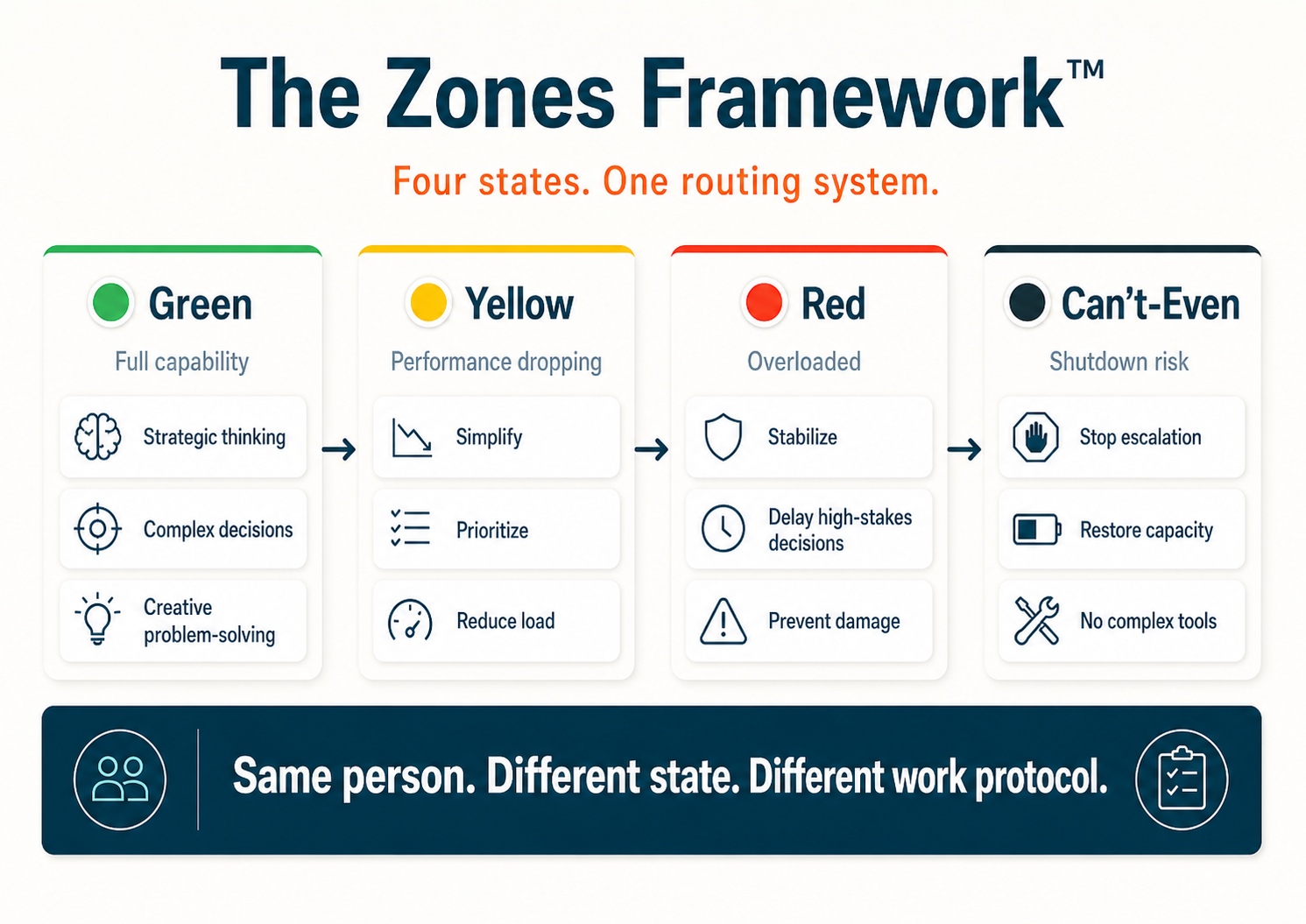
The Zones Framework™ as shared organizational language
Green, Yellow, Red, and Can't-Even become the vocabulary managers and teams use in real time, so everyone speaks the same language about the same variable. The internal license covers all materials, training, and operating systems.
Manager Capacity Certification, in annual cohorts
A certified cohort of managers each year, learning to read capacity signals, time decisions against state, and manage the work demand flowing through their teams. Year one certifies your priority cohort; following years build depth. Certification belongs to the manager and stays with your organization.
Organizational Capacity Dashboard
Aggregate capacity visibility at the team and division level, not individual surveillance. The dashboard tracks a defensible floor plus separate additions, never one blended figure. The floor is the operational capacity cost (output lost in degraded states, from your own data), with Meeting, Decision Density, and Manager Load as lenses that explain it rather than add to it. Recovery Debt (attrition replacement) and Forfeited Upside (co-authored from your pipeline) are reported separately on top of the floor.
What is built today: survey-based capacity-state reporting and the Five Taxes framework. On the roadmap: calendar, Slack, Microsoft Teams, and project-tool integrations, sequenced across the first license year. We walk through exactly what is live and what is coming during scoping. We would rather under-promise here than oversell.
Ongoing strategic partnership
Quarterly capacity reviews with your executive team, each one tracking the top-line number and the patterns driving it. Annual capacity audit on Scale and Enterprise tiers. Access to framework updates, new pillar releases, and the research team. An operational partnership, not a software subscription.
How Deployment Works
Contract-to-live runs 45 to 60 days: legal and privacy review, SSO setup, app provisioning, the first manager cohort selection, and the framework rollout in internal communications. The first executive read of dashboard data lands about 90 days from signing, once enough capacity-state data has accumulated to be worth reading.
From there the system runs and deepens. Manager cohorts cycle through certification. Dashboard integrations come online on the schedule set during scoping. Quarterly reviews keep pulling the conversation back to the top-line number and what is moving it. The annual audit on Scale and Enterprise produces the outcome data that justifies renewal.
Year-one outcomes are directional projections built on pilot data and the underlying research. The license model itself has not run at production scale yet, so the realized shape gets specified during scoping with your organization, not pre-promised on a public page. We will publish the realized range from first deployments forward.
Who The License Is For
Organizations ready to manage capacity at scale, after the evidence is in.
We license across four sectors: pharma and innovation-dependent organizations, financial services and investment firms (private equity is a current priority focus), professional services and law, and healthcare and clinical operations. Pricing applies to the knowledge-worker population whose output depends on cognitive performance under pressure, not total headcount. Many organizations start with a single division or business unit and expand through license amendments.
License Tiers
Three tiers, differentiated by support depth, certification cohort size, and analytics customization. All include the full app and framework.
Foundation
$480/employee/year
Minimum population: 200 employees
Minimum annual contract: $96K
Full app access. Zones Framework licensed for internal use. One manager certification cohort per year (up to 30 managers). Standard dashboard, phased through year one. Quarterly executive reporting. Email support.
Best fit: organizations that have completed a Pilot and are ready to scale across a defined knowledge-worker population.
Scale
$600/employee/year
Minimum population: 500 employees
Minimum annual contract: $300K
Everything in Foundation, plus two certification cohorts per year (up to 60 managers), advanced dashboard with custom integrations on the phased schedule, and the annual Capacity Audit included. Quarterly strategic partnership calls. Priority support.
Best fit: mid-market and enterprise organizations deploying capacity as infrastructure, with internal L&D and Operations alongside.
Enterprise
Custom pricing
Typical contract: $1M+ annually
Everything in Scale, plus unlimited certification cohorts, fully customized dashboard and analytics, dedicated customer success lead, framework adaptation for industry-specific contexts, executive advisory, and a named team supporting the account.
Best fit: large enterprises where capacity management is a board-level priority.
Multi-year commitments get preferential pricing. Audit and Pilot fees credit against first-year license costs. Design Partners receive 15% off first-year license fees. Entering directly at the license stage, skipping the Audit and Pilot, takes a longer ramp and needs executive sponsorship to match. We talk through fit during scoping.
Who Delivers the License
A senior consultant leads deployment and owns deployment planning, certification delivery, the quarterly reviews, and the annual audit on Scale and Enterprise. The same person is available through the engagement and into renewal. You are not handed off mid-engagement.
For Design Partner deployments, the founder is closer at named moments: methodology shaping at kickoff, dashboard configuration review, and quarterly executive readouts in year one, plus executive escalation throughout. Once the firm scales past the design partner phase, that level of involvement ends.
Background. 45+ years of enterprise systems work, including nine years as lead architect on mta.info, the public infrastructure for the Metropolitan Transportation Authority. The methodology is documented in CAPACITY: The Variable No One Measures.
2026 Design Partner Cohort · Three Slots
Early adopters shape the category.
The license model has not run at production scale yet. The first three deployments shape what production-scale capacity infrastructure becomes. What the slots trade is access:
- Founder involvement at the key moments (methodology shaping at kickoff, dashboard configuration, quarterly readouts in year one), which ends once the firm scales past this phase.
- Methodology shaped to your organization while production-scale deployment is still being defined.
- Anchor case-study positioning, permanently, plus 15% off first-year license fees.
Questions We Get
Do we need to complete a pilot before licensing?
For most organizations, yes. The pilot produces the baseline the license economics track against and the internal case study that justifies the investment. You can enter directly with the right executive sponsorship and an appetite for a longer ramp, but the pilot path produces faster buy-in and a cleaner before-and-after for whoever defends the budget.
What's the privacy architecture?
Individual app usage is private. No manager dashboards showing individual behavior, no employer visibility into who used which tools when. The organizational dashboard aggregates at the team level with minimum cohort sizes that prevent individual identification. Your legal and IT teams review the EULA and privacy architecture during scoping. This is the architectural foundation that makes the license work: the workforce uses the app because they trust it.
Can we license only part of the organization?
Yes, and that is the standard shape. Pricing applies to the knowledge-worker population, not total headcount. Many organizations start with a division, business unit, or leadership cohort and expand through amendments. Organizations that start scoped and expand tend to outperform those that start broad.
What's the commitment, and what happens if we don't renew?
Standard terms are annual, with 2 to 3 year options at preferential pricing. If you do not renew, manager certifications stay with your managers and your organization, and dashboard data is exportable. Licensed app access ends at license end. Trademarked terminology and branded content revert to Emergent Skills, but the capacity principles your organization has internalized remain fully usable.
Let's Talk About Your Organization
Licensing is a multi-stakeholder conversation: HR, Operations, Finance, Legal, IT, each with questions worth answering carefully. We run these as long as they need to run. If capacity infrastructure is going to live inside your organization, the decision should take the time it takes.